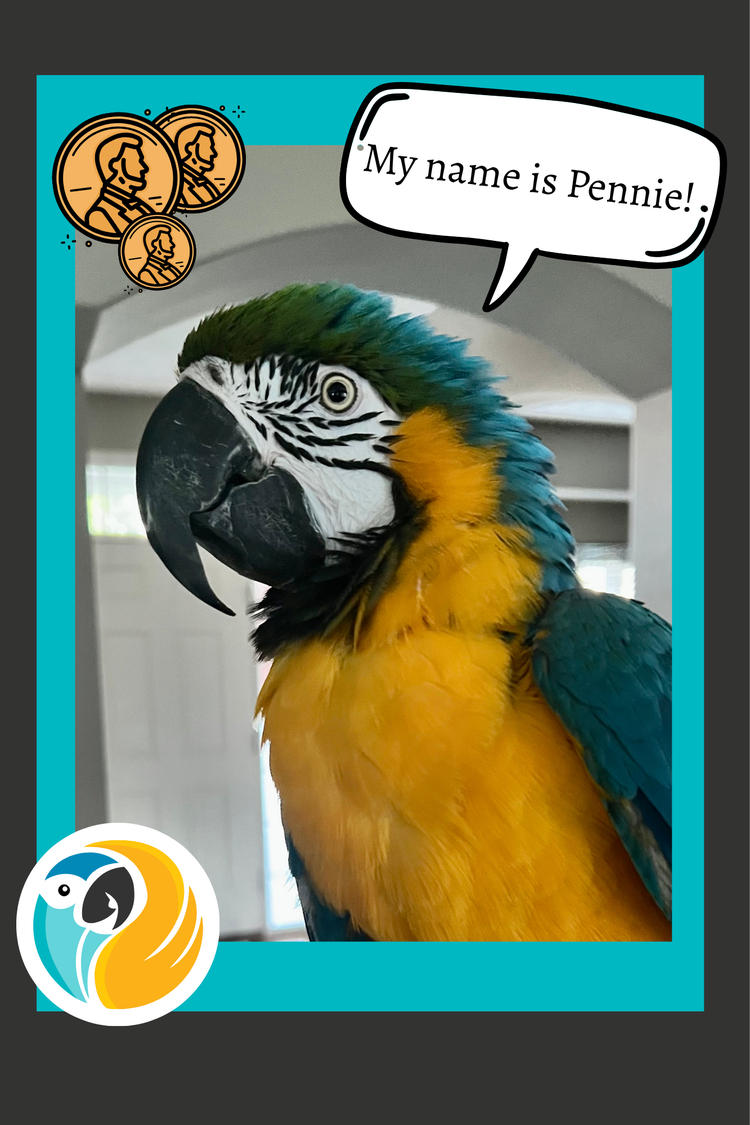
Pennie
Pennie is a beautiful, approximately 18-year-old female blue and gold macaw with a gentle, intelligent, and cautious personality. After spending 15 years with her previous owner, she is adjusting well to foster care and looking for a loving forever home. Pennie enjoys being part of household activities, playing with foraging toys, shredding wood and cardboard, listening to music, and showing off her vocabulary with words like "hello," "goodbye," and "step up." She has a strong preference for men but can build trusting relationships with women through patience, positive reinforcement, and consistent interaction. Pennie thrives in a calm to moderately active household, preferably with older children, and needs daily out-of-cage time, plenty of enrichment, and a healthy diet to maintain her weight. She can be vocal, especially in the evenings, so a detached home is required. With an understanding family that respects her boundaries and provides plenty of attention, Pennie will make a wonderful and rewarding companion.
You may remember Angel, the blue and gold macaw we had last year, and lost when she was not able to recover from the anesthesia after a critical surgery. It seemed a little serendipitous when, earlier this year, we took in another blue and gold macaw named Pennie.
Pennie is a female macaw (verified through egg laying) and about 18 years old. She was surrendered after her owner, who loved her for 15 years, began travelling more extensively for work and Pennie was uninterested in working with other members of his family. It is always difficult for parrots to be uprooted from the people and places they know, but Pennie has done remarkably well in a household with someone who is familiar with macaws where she is being fostered.
While her foster wishes she had a little more of an appetite sometimes, Pennie seems to try new foods with great interest; if she gets the same fresh foods for several days in a row, however, she is less enthusiastic. In the mornings, Pennie joins her foster to make breakfast for all the birds, and often enjoys one frozen blueberry and a tiny lick of all natural applesauce. In her cage (which is in decent condition and will last her probably another 5-10 years), she gets a mix of fresh veggies, grains, and cooked legumes. Around lunchtime, the fresh food is exchanged for Harrison’s High Potency pellets — recommended by our avian vet, as Pennie tends to be a little under weight (but she does eat the pellets well). Depending on what veggies her foster family is preparing each day, she also enjoys a chunk of something else now and then: raw carrots, cucumbers, and beets, and cooked sweet potatoes and whole grain pasta have been favorites in the past. This diet should be continued with her new adoptive family.
Pennie’s former owner cautioned that she only likes men, but we usually take that with a grain of salt. Some birds really do have preferences, while others just need someone they connect with easily or who can read parrot body language and is respectful of boundaries. We can confidently say now that Pennie really prefers men/male energy. Her primary caretaker in foster is the woman of the household, and Pennie will work with her (particularly for a piece of nut or other treat), but she will not seek her out or allow her to give head scratches. The foster has been patient with Pennie, learning her body language and motivations, and can usually get her to step up (particularly if it is for out of cage time or for a bit of a nut). Pennie understands target training, can say “hello” on command, and will raise one foot at a time – all for rewards (nuts), but reliably does so. One thing to note is that Pennie will not step up to a hand – she will easily go to your forearm, and she has not used that opportunity to climb higher to a shoulder.
Still, Pennie is ga-ga for the guys. She will climb (and even hop-fly) to reach the man of the house, and gets very excited when she has a vet visit (she has only seen male vets so far) – it is almost embarrassing! She does display hormonal behavior in the presence of men, which is why her foster has been careful to curtail her interactions (lest she become aggressive or try to lay eggs). This does not mean that Pennie’s primary owner should be a man or a woman, necessarily. In fact, her ideal home is probably a male and female couple, where both individuals work with her regularly and include her in their daily lives. To maintain a good balance, in that situation, the female should have the first and most positive interactions with Pennie (offer treats, let her out of her cage, bring her fresh food and toys, etc), while the male can even things out by being the “bad” guy (returning her to her cage, removing old toys, etc). No worries, though, because Pennie will forgive him!
We have taken Pennie to our avian vet a couple of times (she had one beak trim and one nail trim), and the basic health tests they ran came back fine. Even though she had been on a poor quality seed and dried fruit diet, the veterinarian said that she is really in remarkably good health (aside from being a little underweight at times).
Pennie will need a home where she can spend at least an hour (and on most days, quite a bit more) outside her cage. In her foster home, Pennie is not a landshark – meaning that at all costs, she avoids walking on the floor (which helps with the safety of your toes). She can fly, though she does not like to; the times she has flown have been when she is startled by a loud noise or a fast movement near her. Pennie has not had a lot of practice flying (her foster thinks this is where some training from a masculine person might help encourage her), but she tries to land above the floor. This has led to some interesting situations, where Pennie has clung to blinds and bookshelves, according to her foster. The only time that Pennie seems reluctant to return to her cage is when she has settled in for the night on her playstand and does not care to move. In these cases, her foster uses a long perch and Pennie easily steps up and goes back in her cage without a fuss. She will come with a small playstand from her previous home, but her foster notes that she would probably love a larger, and more stable, tree stand.
Initially, Pennie was pretty vocal in her foster home. We advise our caregivers, and new adopters, to keep a parrot new to the household away from other birds for at least 30 days to monitor for any signs of health problems, and this was a bit torturous for poor Pennie. She wants to be in the middle of the action! Her foster family now has her, either in her cage or on her playstand, in their open family room/kitchen space, near two of their resident parrots, though she and her cage return to the attached dining room at night for bedtime. Pennie still yells, usually if the other birds are noisy or if the foster’s dogs are barking, and typically around dinnertime/sundown. She is also known to loudly complain if she is bored or needs to come out of her cage. For these reasons her adoptive home must be a detached house, rather than a home with any shared walls.
Many folks ask if we have any “talking” birds, but we really can’t answer that in a straight forward manner. Most parrots, from budgies to macaws, have the ability to “speak”. Whether they do or not (and whether it is easy to understand them or not) comes down to the individual bird. Some birds never speak, and sometimes, some birds never stop talking! But most parrots do have at least one or two words, though the environment they are in dictates whether they will talk or not. Another thing to keep in mind is that human speech only occurs with a parrot when they are in a heightened, or excited, state. Often, this energy can lead to bites and aggression if the people nearby are not careful, so speech is not always a good quality in a parrot. Having said that, Pennie does have a few words: she will say “hello” if she hears a phone ringing or sees someone outside the front door or window or if there are no people that she can see but needs attention (or on cue as noted above); she will will say “goodbye” occasionally but particularly when the man of the house leaves the room; she also often says “step up?” to the man of the house when she would like his attention.
We think Pennie enjoys bathing, but it is something that her new family will need to work on as well. Pennie can be very cautious with her trust, and she has only allowed her female foster to mist her thoroughly with a spray bottle so far. She does show a bathing response (meaning she will lean over and spread her wings so that water lands everywhere), but occasionally if the session has gone on longer that she prefers, Pennie will lunge and try to bite at the bottle. Her previous owner noted that he would take her into the shower on her playstand and turn on the water, but so far, Pennie has been fearful of even entering the bathroom, let alone the shower.
Pennie’s new family should expect to spend a good bit of money on toys for Pennie every month. Her favorite toys have a nut or other little treat hidden inside (foraging toys like cardboard cubes or wood boxes she has to manipulate have been quite enjoyed). These toys are high value to Pennie, though she does go through them in minutes. She will chew toys with thin pine planks, and lately she has been enjoying snapping wood beads off of toy cords. Other forms of enrichment and foraging that Pennie has enjoyed include wrapping both her pellets and a couple of nuts in clean brown paper and putting them in her food dish, being encouraged to walk across new surfaces (like the kitchen counter) by placing a nut some distance away, and playing different kinds of music for her (she will “dance” if a male is present). Making some of her toys can help defray the cost (using clean cardboard, strips of acid- and lignin-free paper, and unused paper straws and coffee filters, for example). Pennie also loves to destroy birdie bagels (look them up, they are real!).
Pennie is generally a cautious bird, even after several months. Her foster family thinks she would do well in a household with medium to low energy; middle school aged children and older will not likely bother Pennie, but the quick movements of younger kids make her nervous. Pennie’s foster says she is the least aggressive macaw she has met to date: while Pennie is not overly friendly and outgoing (well, at least with women), she will give you the space that she expects in return. She is very good with her body language and because she gives every warning before she feels threatened enough to bite, she has not done so in her foster home.
Do you think your home might be a good fit for Pennie? Fill out an application today!