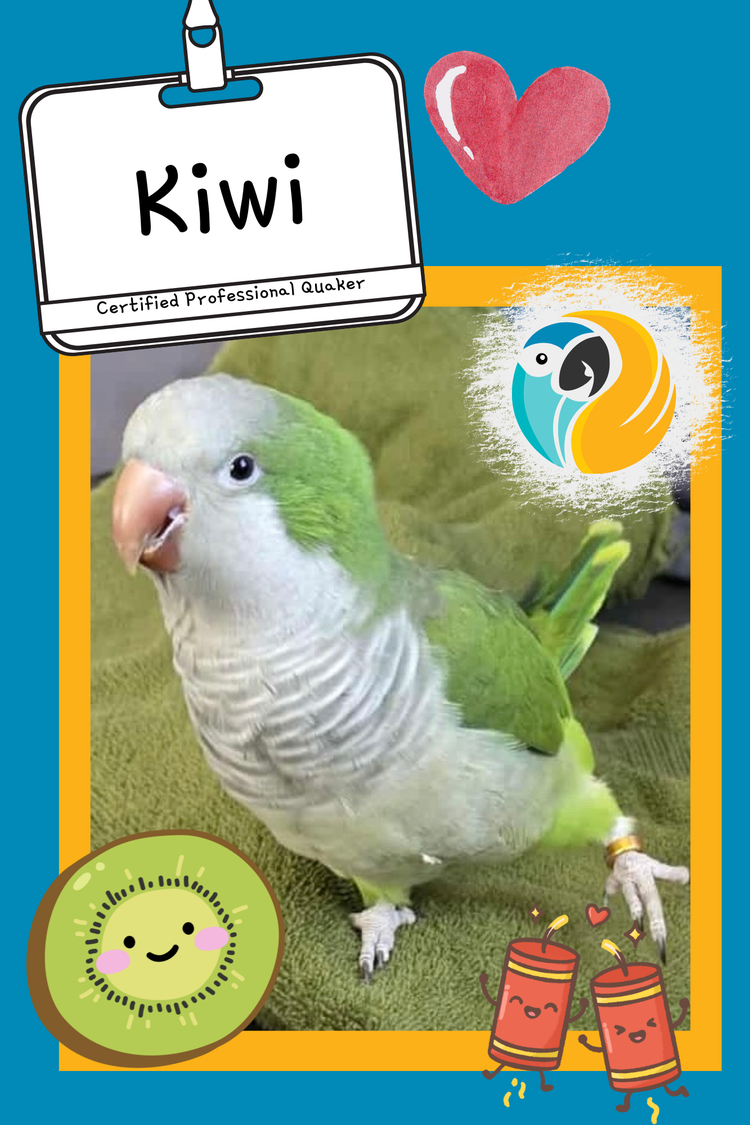
Kiwi
Kiwi is a spirited, approximately 3-year-old Quaker parrot with a big personality, impressive talking abilities, and plenty of energy! She loves mimicking words and phrases, playing with and shredding toys, flying, and getting attention from her humans. While Kiwi is entertaining and intelligent, she can also be extremely loud, territorial, and prone to biting, making her best suited for an experienced, patient bird owner ready to invest time in positive reinforcement training. Kiwi has an unusual leg posture and occasional balance issues, though veterinary evaluations have not indicated current pain. She has successfully transitioned to a healthier diet of pellets and fresh vegetables and grains. Kiwi needs daily out-of-cage time, plenty of enrichment, and a stand-alone home where her vocalizations won't disturb neighbors. With consistent training, patience, and understanding, Kiwi has the potential to become a wonderful companion for someone ready to embrace her feisty personality.
If you are looking for a challenge, or a “project bird”, we have the perfect parrot for you: Kiwi! You might think she looks as sweet as a little kiwi (and we agree!), but she also has a lot of qualities in common with a lit firecracker.
Kiwi is a quaker (also known as a monk parakeet), about 3 years old, and while we say “her” we don’t know whether she is male or female. Previously, she belonged to a young girl, and unfortunately, learned to communicate her needs in a not-so-sweet way.
First, a few basics. Kiwi came to us on a seed diet, but her foster was able to convert her easily to eating Zupreem fruit blend pellets and a fresh veggie and grain chop. She still gets a couple of seeds a day, but they are given by hand and used as tools for bonding and training. As a big treat, she enjoys a Nutriberry, but sunflower seeds seem to be a hit for training especially.
When we first met Kiwi, we wondered if some of her “explosiveness” might be due to pain or discomfort: Kiwi does stand and perch in a sort of splay-legged position, and will occasionally fall in her cage. She did see our avian vet, and they advised us that her knees (or that joint anyway) were turned outward, but the exact cause was unclear. They suggested it might be an issue with her hips, but in order to properly diagnose (and possibly fix) the problem, she would need further x-rays and tests, and even then, it might turn out to be something that cannot be fixed. While birds are with us at HARP, we want to ensure that they are not in any current pain and address any health problems that come up, but we also take the medical advice of our avian veterinary team very seriously. While the vet was working with Kiwi, they said that she did not seem to be in pain even when they were manipulating the joints, but they sent an anti-inflammatory home with the foster to see if it would change anything for Kiwi. After a week of the meds, it did not seem as if they did much to help her, and so her foster stopped using it. This is all good information for Kiwi’s new family to have, if they decide to pursue a “fix” or find that her posture begins to deteriorate at some point in the future. For now, her foster has added some padding to the bottom of her cage to lessen the risk of injury should she happen to fall.
Kiwi will need an appropriate cage when she goes to her forever home; the cage she arrived in was far too small for a bird her size. The Association of Avian Veterinarians recommends that quakers (also known as monk parakeets) need a cage that is at least 27” wide by 24” deep, with no more than ½” bar spacing. If you can find a larger cage with ½” bar spacing, even better: while her new family works on training and developing a trusting relationship, a lot of that can be done while she is inside a cage and will limit her ability to bite at hands. (Do not purchase a cage until you have been notified that your adoption has been approved by HARP.)
Let’s go back to the comparison to a firecracker, and rate her on a scale of * (it’s not an issue one way or another!) to ***** (something she is very good at, for better or worse).
ENTERTAINMENT VALUE (SPEECH): *****
One way that Kiwi uses to get attention is her ability to mimic human speech – and she is pretty good at it! She can do all the “viral” hits, like Bacon Pancakes and Cookie Cookie. She also says things like, Here kitty kitty, whatcha doin, and peekaboo. She enjoys doing a sort of “rap” version of pretty bird; she barks and wolf whistles, and has a whole bunch of other garbled words and phrases that she is still working on! Not all birds will mimic speech, and their interest in doing so will vary depending on the reinforcement they receive, but we understand that Kiwi did talk in her last home, so chances are good she will talk for you.
NOISE: *****
If Kiwi can not get your attention with her speech, she will scream. A lot. Very loudly. Often, the pitch is similar to the screech of a young girl. Parrots do tend to make noise at sunrise and sunset, as this is the time of day when birds naturally flock call. However, when the screaming is reinforced through attention or even treats (aka, bribes, because you can’t scream while you are eating), it becomes a difficult loop to get out of. Time spent reinforcing CALM or quiet (even if it is a little seed when she stops to take a breath!) will be important in Kiwi’s new home. Another way to calm an overly excited bird is to introduce bath time. Her foster has not seen her bathe in her cage, however, and has not worked with her on this particular issue, but if you can successfully introduce a shower by using a spray bottle, and she enjoys doing it, it can be a great tool. It should never be used as a punishment, but if a bird will stop to bathe, their whole mindset gets a chance to reset – kind of like a warm bubble bath. But no bubbles for birds. Because Kiwi has the ability (and for now, the inclination) to be very, very loud, she will need a family with an unattached, single house.
FUN AND FRIENDLINESS: **
Kiwi loves to be around people, and attention from humans is a big reward for her. Again, however, she has learned that things like biting (see next) and screaming will get a reaction from people, and whether that’s a good or a bad reaction, she does not care. Any and all attention is fun and entertainment for her. Kiwi does need out of cage time to be able to climb and explore (and work off some of that pent up energy!), and she will try to climb up arms to get to shoulders to bite heads and faces. (Again, big reaction = lots of fun for Kiwi!) Her new family will need to understand that her bites are not personal – she doesn’t hate you, but rather, wants your attention! Kiwi just doesn’t know any other way to tell you that. She does not understand the request to step up – so again, lots of things to teach her! For someone who has the patience and time to work with her, she should be an easy bird to train and Kiwi has the potential to be a very cool friend.
DANGER (BITING AND AGGRESSION): *****
Public PSA: don’t give a lit firecracker to a young child. They may not come away with injuries requiring a hospital visit, but it’s a chance you really don’t want to take. Same thing with Kiwi. Most days, if you asked her foster, little Kiwi will choose violence. If you’ve read this far, you know why! But it bears repeating, that at this point: Kiwi bites. Often. Very hard. And she will continue doing so until she learns another way to communicate. Like many quakers, Kiwi can be cage aggressive, so even under the best circumstances, do not reach inside her cage. It’s not respectful, and she will come after you. By attaching a perch to the door, you are creating a bit of a neutral zone when you open it to give her out of cage time. Her foster still uses a towel to gently pick her up and move her to a safe place to hang out. Kiwi can not fly at this time: her young owner clipped her wings very, very short (another reason she may have trouble balancing), and it will take time for them to molt and all grow in again. She acts like she wants to fly, though, and truthfully, some of her aggression may be due to the fact that she can not perform this very instinctive bird activity. While flightless birds can exercise and be active by climbing and walking, wing clipping often leads to very serious mental health issues for birds, which is why we discourage it unless it is medically required by an avian vet. UPDATE: Kiwi can, and does, fly now! As she is practicing, she is getting better at it, and it is very good exercise for her. She will need to spend time outside her cage daily to fly and explore; sometimes, she will fly intentionally to her foster for some social time, which unfortunately still includes biting more often than not.
EXPENSE (AKA, TOY AND VET BUDGET): ***
Kiwi loves to destroy toys – which is great news, because that means she will spend less time trying to destroy your home! She particularly enjoys toys made of cardboard and soft woods (sola, balsa) that she can easily rip up. Kiwi’s foster has found that she will snip the cords to toys hung from the top of her cage before she can actually play with them, but she usually does better when they are hung from the side of the cage. She goes through toys quickly, but the materials can be easy to source and with a little research you can make your own, though toys for her size of bird are usually more affordable than those required by larger birds. Predicting vet costs is somewhat more difficult, but like any companion animal, Kiwi will need to see an avian vet at least annually, and as she gets older, she may need to go more frequently. Unforeseen emergencies do happen, and they can be costly, but preventative care goes a long way as well. As a rescue we have had emergency care bills range from $150 to more than a couple thousand, so regularly putting cash aside for a “parrot emergency fund” is often a good idea.
If you are up for the challenges and rewards that Kiwi comes with, we want to meet you! Please fill out an adoption application today!