Bubba
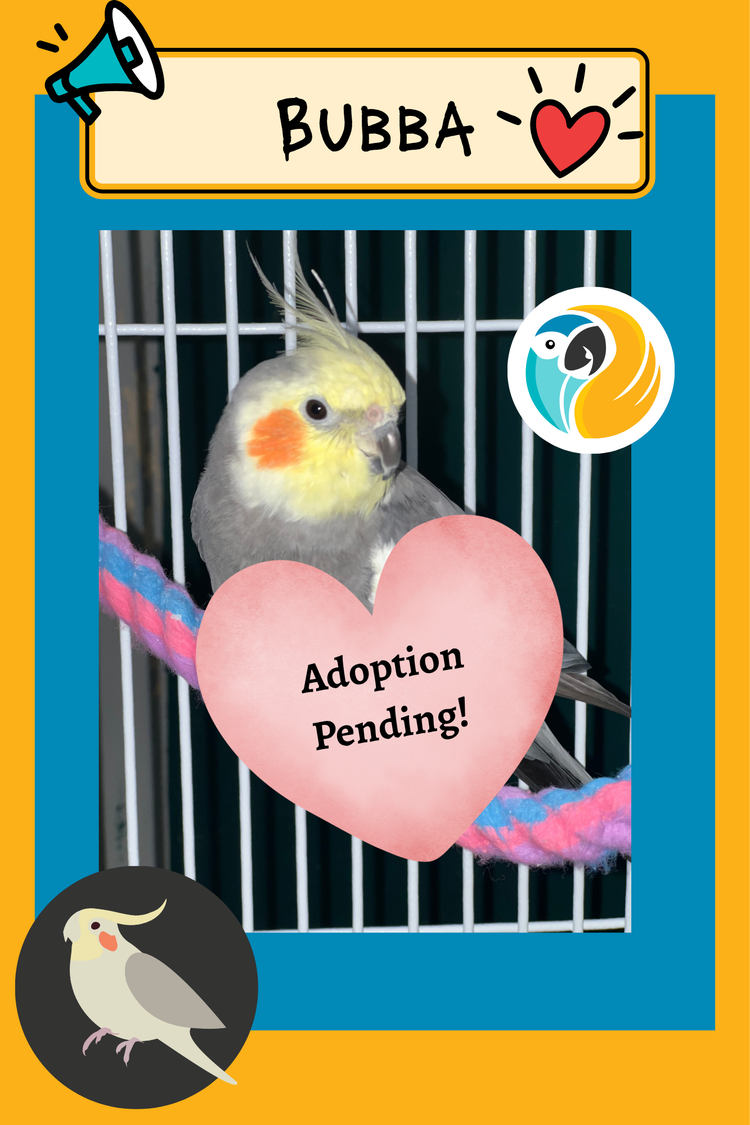
Bubba is a charming, approximately 7–8-year-old cockatiel with a playful personality, a love for whistling, and a strong desire to be part of the family. Though initially nervous around new people, Bubba enjoys attention, watching TV, observing household activities, and exchanging whistles with his favorite humans. He can be selective about when he wants to leave his cage or interact, so patience and respecting his boundaries are essential. Bubba is generally quiet, though he occasionally calls out for attention, and he may enjoy having another similarly sized bird nearby for companionship. He has successfully transitioned to a healthier pellet-based diet and enjoys occasional bathing. His new family should provide a spacious cage in a busy area of the home, opportunities for supervised flying, and daily interaction to help build his confidence. With patience, understanding, and gentle encouragement, Bubba could make a wonderful companion, even for a first-time parrot owner.
Our friend Bubba would like to say “hello”, but he is a little nervous around new people. Fortunately, he can’t hide his big-bird-antics-packed-in-a-little-bird-body for long!
Bubba is a cockatiel, believed to be male and about 7-8 years old. He came to us when his previous owner’s health was in decline, and the cage he had been confined to for many years was too small for a cockatiel, so prospective adopters should keep in mind that he will need a cage. The cage that was sourced for him by HARP is a larger size for him, and his fosters report that he does appreciate the additional space (we will share details about cage size requirements, including bar spacing, during the home visit phase of our process). At night, his previous owner covered his cage, which can create a sense of comfort for some parrots.
Upon placement in his temporary home, Bubba’s fosters encouraged him to leave his cage and interact with them, and he was extremely outgoing and seemed happy to explore the world outside of his cage. This foster home does have dogs and a cat, so while Bubba is used to them (smaller dogs and cats in particular), his cage is never open while the other animals are out. Bubba’s wings do not appear to have been clipped, but he is a somewhat clumsy flier. For parrots that were hand-raised and cage bound, this is not unusual; while the wild instinct is there to fly, parrot babies fledge from their nest with guidance and lessons from their parents; if this is not allowed to happen, a bird can learn on their own, but caretakers will need to be especially watchful and provide spaces with soft surroundings to guard against injuries.
Like many birds, Bubba will usually seek out the highest places to perch, whether he is inside or outside of his cage. Many people will tell you this is because they are trying to assert dominance, but parrots, being prey animals, are not concerned with dominance. Instead, a high place to perch allows them safety, as they will be able to see danger coming in time to react appropriately. Fortunately, Bubba will return to his cage easily, as he still sees it as a place of comfort.
More recently, Bubba has not been interested in leaving his cage, even when the door is open. If his foster asks for a step up when the cage is open, he will only oblige if he is ready to have some out and about time. Otherwise, he will hiss – birds give plenty of warning before they resort to biting, and Bubba is no different!
Regardless of whether he is inside or outside of his cage, Bubba has some serious FOMO (fear of missing out)! His (sturdy) cage should be in a high-traffic area of the home, preferably where someone is almost always hanging out. If he can hear his preferred foster parent but not see them, he will flock-call to them with a special tune, and expects to hear that sound returned to him – this tells him, I am here, I will be back in eyesight soon, don’t worry! Parrots are very social creatures, and most species (including cockatiels) are very rarely ever alone in their natural surroundings. If necessary, and usually only around 9am, Bubba will alarm call pretty loudly, but otherwise his foster reports he is typically a pretty quiet bird. He loves whistling, and tries to mock whatever tune or whistle his human friends test him on. When the resident dogs are barking, Bubba will squawk along with them just to be part of the noise. While he will need to have his cage to himself, his foster believes that he might like to have another similar sized friend to whistle back and forth with when the people of the home cannot be present.
We did mention Bubba’s “preferred foster parent”, and that is another thing to be mindful of: while Bubba will likely engage with almost anyone willing to give him some attention, he does tend to pick out one person and pine after them. He will also, however, change who that person may be without any warning or apparent cause – and Bubba says he reserves the right to do so! It’s not personal, and chances are, he will change his mind again after some period of time.
Although Bubba’s foster family has introduced several different kinds of toys, he has really only played with one so far. He does love playing with it, they report, and they are working with him to see if they can find more that will capture his attention, but his adoptive home will also need to work on this. His current preferences seem to be sitting on a rope perch, playing with that one toy, paying attention to the TV when the family is gathered around, observing the dishes being done, and whistling back and forth with his human companions. His foster family also moves his cage around the room now and then, so he has a different view and for them to monitor what space he seems to prefer.
Initially, when Bubba would come out of his cage, he would occasionally dip under a running faucet and take a quick little shower. Within his cage, his foster does offer misting sprays, and he has a bathing dish in his cage. Cockatiels are a dusty species as a rule, but providing opportunities for bathing a few times a week will cut down on this dramatically.
Bubba came to us on a seed diet, which is not the ideal source for most of a bird’s nutrition. Happily, Bubba transitioned to Zupreem pellets with millet as a treat (using it for bonding or training is a great way to offer it!). Like many parrots, Bubba does seem to like eating socially, and if he is out of the cage he may try to steal food off your plate! While there are many foods that birds should never have access to (chocolate, avocado, xylitol and caffeine are just a few that are toxic to parrots), things like a bite of plain pasta a couple times a week or undressed lettuce salads are great foods to share with your bird!
We rely on our volunteer foster families to help us find the best families for each of our birds! Bubba’s foster notes that he will need a home that is patient and okay with a bird who may not want to fully interact with them. They should be willing to take time to work with him daily, especially in regards to leaving his cage, as that is all he has known for so many years. With some dedication, Bubba could be an excellent bird for a first-time parrot caregiver! If you think you could offer Bubba a happy place to perch for life, please fill out an application today!